Class 6–8Class 9–10Class 11–12College
Electrolysis of water
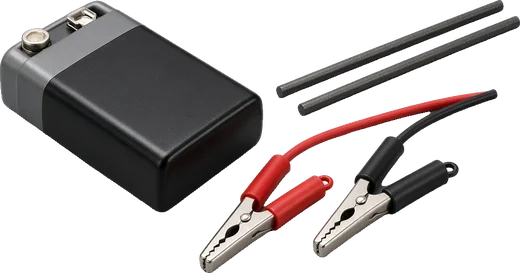
Electricity can split water into two gases, hydrogen and oxygen. You always get twice as much hydrogen!
An electric current splits water. Hydrogen forms at the negative electrode and oxygen at the positive one, in a 2 to 1 ratio by volume.
2 H₂O → 2 H₂ + O₂2 H₂O(l) → 2 H₂(g) + O₂(g)
water → hydrogen + oxygen
Why?
Water is H₂O, with two hydrogen atoms for every oxygen atom, so it gives twice as many H₂ molecules as O₂ molecules.
College
At least 1.23 V is needed in theory (in practice more). Splitting 2 mol of liquid water needs ΔH = +572 kJ.
(−) 4H₂O + 4e⁻ → 2H₂ + 4OH⁻
(+) 2H₂O → O₂ + 4H⁺ + 4e⁻
E°cell = −1.23 V · ΔH = +572 kJ·mol⁻¹
▶
- Pour water into the beaker until the tubes are covered.
- Tap the jar to stir in sodium sulfate so the water conducts.
- Tap the battery to switch on the current.
- Hydrogen (left) collects twice as fast as oxygen (right).
⚠ Safety
Only use a low-voltage battery, never mains electricity. Hydrogen is flammable, so keep it away from flames.
⭐ Fun fact: Some buses run on hydrogen made this way.