Angles in a triangle
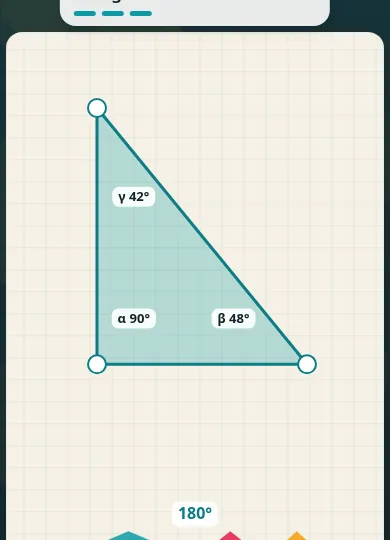
The three corners of any triangle can be torn off and laid on a straight line. A straight line is a half-turn, 180°, so the three angles always add up to 180°.
An acute triangle has all angles less than 90°, a right-angled triangle has one angle of 90°, and an obtuse triangle has one angle greater than 90°. In every case the sum is 180°.
the three angles of a triangle add up to 180 degrees
Why?
Draw a line through one vertex, parallel to the opposite side. The two outer angles are alternate angles with the base angles, so they equal them. Together with the third angle they make the straight line at that vertex.
College
This is equivalent to Playfair’s form of the parallel postulate: in Euclidean geometry the angle sum is 180°. On a sphere the sum is greater than 180°; on a hyperbolic plane it is less.
▶
- Drag the corners. Watch the three angles — they always add up to 180°.
- Make a different kind of triangle (acute, right or obtuse), then tear the corners onto a straight line.
- The three corners make a straight line: that is 180°.
⭐ Fun fact: The Baudhāyana Śulbasūtra, a Sanskrit text more than 2,000 years old, already used right triangles and the relation we now call Pythagoras’ theorem.