Shapes and symmetry
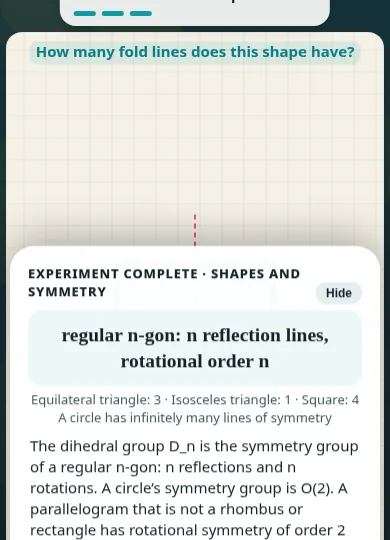
A fold line (a line of symmetry) is a line you can fold along so both halves match exactly. A square has four, a rectangle has two, and a butterfly’s body is a fold line too.
A regular polygon has all sides equal and all angles equal, so it has as many lines of symmetry as it has sides, and you can also turn it about its centre onto itself n times. A circle matches after any turn, so it has infinitely many fold lines.
a regular shape with n sides has n fold lines
Why?
A reflection is a congruence. If a fold maps the shape onto itself, every point has a matching point the same distance the other side of the line.
College
The dihedral group D_n is the symmetry group of a regular n-gon: n reflections and n rotations. A circle’s symmetry group is O(2). A parallelogram that is not a rhombus or rectangle has rotational symmetry of order 2 but no reflection lines.
▶
- How many fold lines does this shape have? Choose a number and press Check.
- Correct! Try another shape.
- You found the fold lines of three different shapes.
⭐ Fun fact: Snowflakes usually have 6-fold symmetry, like a regular hexagon, because of the way ice crystals grow.