Pythagoras by rearranging
On a right-angled triangle, the square built on the long side (the hypotenuse) has the same area as the two squares built on the short sides, put together.
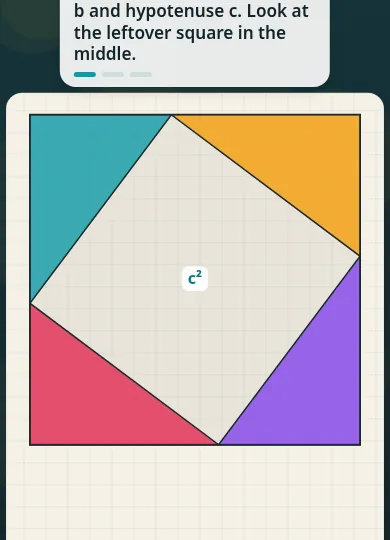
Four copies of the triangle sit inside a large square of side a + b. In one arrangement they leave a square of side c. In the other they leave a square of side a and a square of side b. The large square and the four triangles do not change, so the leftovers are equal: a² + b² = c².
the square on the long side equals the two squares on the short sides, added together
Why?
Area is conserved under moving the pieces. The outer square has area (a + b)² = a² + 2ab + b². Four triangles have total area 2ab. Subtracting leaves a² + b², and also c².
College
This is Euclid’s Elements I.47. The converse (I.48) says that if a² + b² = c² then the angle opposite c is right. Any similar figures on the three sides work, not only squares (VI.31). In India the same relation appears in the Baudhāyana Śulbasūtra.
Four triangles use 2ab; the leftover is a² + b², and also c²
▶
- A right triangle has sides a, b and hypotenuse c. Look at the leftover square in the middle.
- Press Rearrange. The same four triangles now leave two squares, a² and b².
- Change a or b. The two leftover areas stay equal: a² + b² = c².
⭐ Fun fact: There are hundreds of proofs of Pythagoras’ theorem. James Garfield, later a US president, published one in 1876.