Areas that slide
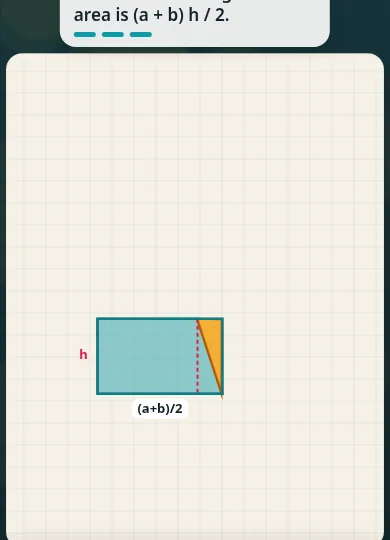
You can cut a leaning shape and slide a piece over to make a rectangle, without adding or losing any area. So the leaning shape and the rectangle have the same area: base times height.
A shear slides the top of a parallelogram sideways but leaves the base and the height unchanged, so the area does not change. A trapezium has one pair of parallel sides a and b; two copies make a parallelogram of base a + b, so one has area (a + b) h / 2.
parallelogram area = base × height; trapezium area = average of the two parallel sides × height
Why?
Cavalieri’s idea: slices of the same height and the same length have the same area. Sliding a triangle sideways is an isometry of that piece, so the total area is preserved.
College
In vector geometry the parallelogram spanned by u and v has area |u_x v_y − u_y v_x| = |det(u, v)|, which equals base × height. The trapezium formula is the average of the two bases times height, the same as the integral of a linear width.
Two congruent trapeziums make a parallelogram of base a + b
▶
- Look at the parallelogram. Its area is base × height, even when it leans.
- Press Cut and slide. A triangle moves and the shape becomes a rectangle of the same area. Then try the trapezium.
- A trapezium (trapezoid) becomes a rectangle too: its area is (a + b) h / 2.
⭐ Fun fact: The British and Indian word is trapezium (parallel sides a and b); in US English that shape is usually called a trapezoid.