Lines and parabolas
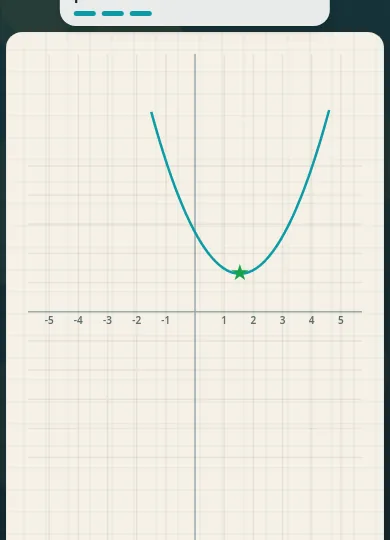
A straight line climbs at a steady slope. The number m is how much it goes up for each step across, and c is where it crosses the up–down axis. A parabola is a U-shaped curve with a turning point called the vertex.
The unique straight line through two points (x₁, y₁) and (x₂, y₂) has slope m = (y₂ − y₁)/(x₂ − x₁) and intercept c = y₁ − m x₁. A parabola y = a(x − h)² + k has vertex (h, k). If a is positive it opens upwards; if a is negative it opens downwards.
a straight line is y = slope × x + intercept; a parabola can be written from its turning point
Why?
Two distinct points determine a unique line, so there is exactly one pair (m, c) that hits both stars. The vertex form makes the turning point visible: substituting x = h gives y = k.
College
A line is the graph of an affine function. A quadratic y = ax² + bx + c can be rewritten by completing the square as a(x − h)² + k with h = −b/(2a) and k = c − a h². The discriminant b² − 4ac tells you how many roots it has.
Vertex of y = a(x − h)² + k is (h, k); a > 0 opens up
▶
- Move the sliders until the straight line goes through both stars.
- Now switch to the parabola and put its vertex (the turning point) on the star.
- You fitted a line and a parabola.
⭐ Fun fact: The name parabola comes from the Greek for “placed beside”, from the way a cone is cut to make the curve.