Adding forever
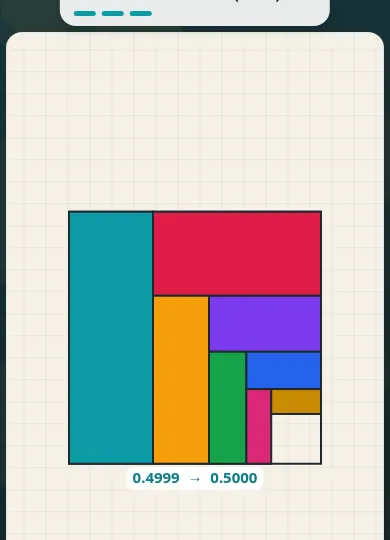
You can cut a square in half, then cut the leftover in half, and so on. The pieces 1/2 + 1/4 + 1/8 + … fill the whole square, so they add up to 1, even though you never stop adding.
Each term is the previous one times r. After n terms the sum is S_n = a (1 − r^n) / (1 − r). If |r| < 1, r^n shrinks to 0, so the infinite sum is a / (1 − r). Here the first term is r itself, so the limit is r / (1 − r): 1 when r = 1/2, 1/2 when r = 1/3, 1/3 when r = 1/4.
a geometric series with ratio r, where r is a fraction less than 1, adds up to a first term ÷ (1 minus r)
Why?
Let S = a + ar + ar² + … . Then rS = ar + ar² + … and S − rS = a, so S(1 − r) = a. This algebra is valid only when the series converges, which for a geometric series means |r| < 1.
College
A geometric series converges in ℝ (and in ℂ) iff |r| < 1. At r = 1 the partial sums are na, which diverge unless a = 0. The remainder is S − S_n = a r^n / (1 − r), which falls geometrically.
r = 1/2 → S = 1; r = 1/3 → S = 1/2; r = 1/4 → S = 1/3
▶
- A square is filled with 1/2, then 1/4, then 1/8, and so on. Add more terms.
- Switch to r = 1/3 or r = 1/4 and add at least 8 terms there too.
- The partial sums climb towards a limit: a / (1 − r).
⭐ Fun fact: Zeno’s paradox of Achilles and the tortoise is an early story about adding infinitely many shrinking pieces to a finite total.