Newton's cradle
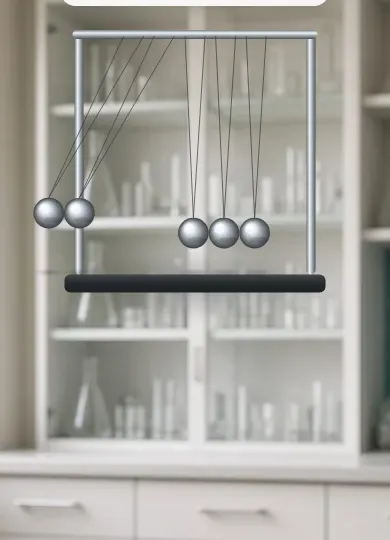
When one ball hits the row, one ball flies out at the other end. Pull two, and two fly out! The push passes through the balls in the middle.
Momentum (mass × velocity) is conserved in every collision. Steel balls bounce almost perfectly, so kinetic energy is kept too. The only way to keep both is for the same number of balls to fly out at the same speed.
momentum before the collision = momentum after the collision
Why?
For equal masses in an elastic collision, the balls simply swap velocities. The impulse passes along the row from ball to ball, so the last ball gets the speed of the first.
College
Conservation of momentum (Σmv) and of kinetic energy (Σ½mv²) together force n balls in to give n balls out at the same speed. The coefficient of restitution here is 0.998, so a little energy is lost on each hit and the motion slowly dies away.
e = (v₂ − v₁)/(u₁ − u₂)
▶
- Press Pull 1 to lift one ball and let it go.
- Now try Pull 2. How many balls fly out?
- The same number of balls fly out as you pulled. Try Pull 3.
⭐ Fun fact: Newton's cradle is named after Isaac Newton, but this desk toy only became popular in the 1960s.