Floating and sinking
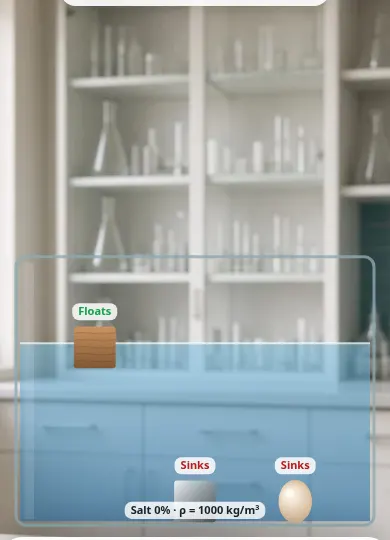
Things that are lighter than the same amount of water float, like wood and ice. Heavier things, like stone and steel, sink. Salt makes water heavier, so an egg can float in very salty water!
Water pushes up on anything in it with a buoyant force. An object floats if its density is less than the water's density. Floating objects sink until they push aside their own weight of water.
an object floats if it is less dense than the liquid
Why?
The buoyant force equals the weight of the liquid pushed aside (Archimedes). A floating object settles where that equals its own weight, so the fraction under water is ρ_object / ρ_fluid.
College
At equilibrium ρ_f g V_sub = ρ_o g V, so V_sub/V = ρ_o/ρ_f. Ice (917 kg/m³) floats 92% submerged in fresh water. An egg (about 1030 kg/m³) sinks in fresh water but floats once the brine density passes 1030 kg/m³.
F_b = m_fluid · g
▶
- Tap an object to drop it into the water.
- Try more objects. Which ones float and which sink?
- Add salt with the slider. Can you make the egg float?
⭐ Fun fact: The Dead Sea is so salty (about 1240 kg/m³) that people float on it without swimming.