Feather vs ball: free fall
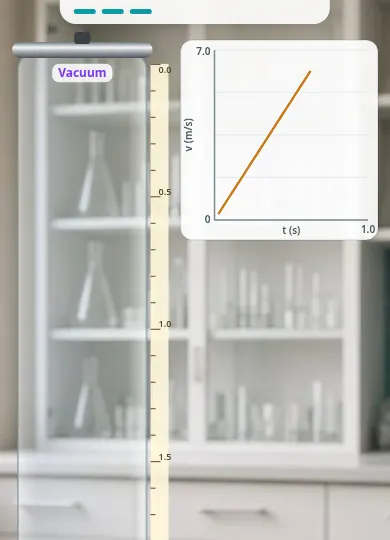
In air, the feather floats down slowly because air pushes up on it. With no air (a vacuum), the feather and the ball fall together and land at the same time!
Gravity speeds up every object at the same rate, 9.81 m/s². Air resistance pushes against moving objects. It matters a lot for a light, wide feather and very little for a heavy ball.
falling time depends on height and gravity, not on weight (when there is no air)
Why?
Weight is mg and gravity's acceleration is g for every mass. Air drag depends on shape, area and speed, so it slows the feather much more than the ball.
College
With drag, m dv/dt = mg − ½ρC_dAv². The feather reaches a terminal velocity of about 0.6 m/s within a fraction of a second, while the steel ball's terminal velocity is about 85 m/s, so over 2 m it behaves almost like free fall.
m dv/dt = mg − ½ρC_dAv²
v_terminal = √(2mg / ρC_dA)
▶
- Press Drop to release the ball and the feather in air.
- Now switch to the other setting (air or vacuum) and drop again.
- Compare the two times. What did the air do?
⭐ Fun fact: In 1971 astronaut David Scott dropped a hammer and a falcon feather on the Moon. They hit the ground at the same time.