Friction on a ramp
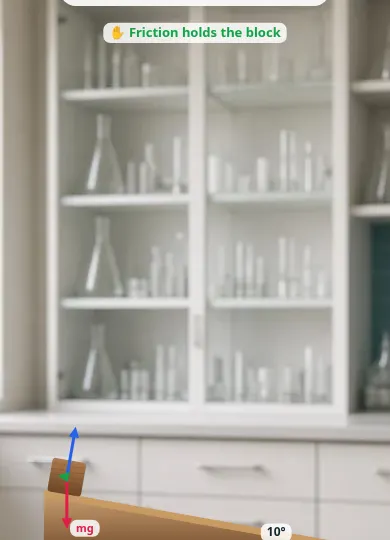
Friction is a force that stops things sliding. On a steep or slippery slope the block slides down. On a gentle or rough slope friction holds it still.
Gravity pulls the block down the slope with a force of mg sin θ. Friction pushes back up the slope. The block slides only when the pull down the slope beats the greatest friction the surface can give.
a steeper slope pulls the block down harder; a rougher surface gives more friction
Why?
Maximum static friction is μ_s × normal force = μ_s mg cos θ. The block starts to slide when mg sin θ > μ_s mg cos θ, that is when tan θ > μ_s. Once moving, the smaller kinetic friction μ_k acts.
College
Newton's second law along the slope: ma = mg sin θ − μ_k mg cos θ, so a = g(sin θ − μ_k cos θ), independent of mass. The critical angle θ_c = arctan μ_s lets you measure μ_s.
F_N = mg cos θ
v² = 2as
▶
- Press Release to let the block go.
- Now make the block stay still: lower the angle or choose a rougher surface.
- Now make it slide: raise the angle or choose a smoother surface.
- You found when friction holds and when it lets go!
⭐ Fun fact: Ice is slippery partly because its surface is covered by a very thin layer of liquid-like water, even below 0 °C.