Light through a prism
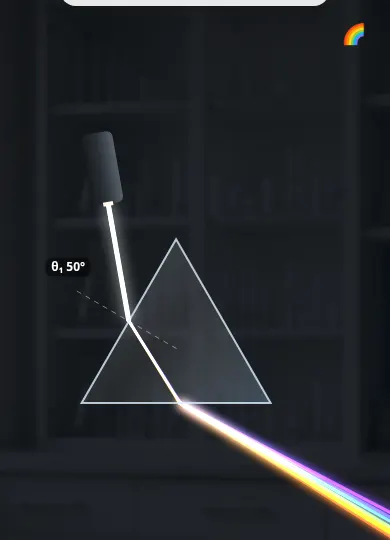
White light is really a mix of all the colours of the rainbow. A glass prism bends each colour by a different amount, so they spread out into a rainbow.
Light slows down in glass and changes direction: this is refraction. Glass slows violet light a little more than red light, so violet bends more and the colours separate. This is called dispersion.
light bends when it goes from air into glass; each colour bends by a different amount
Why?
The refractive index n of glass depends on wavelength: about 1.65 for violet and 1.61 for red in flint glass. Snell's law then gives each colour a different angle.
College
Snell: sin θ₁ = n(λ) sin θ₂, with Cauchy's n(λ) = A + B/λ². If the angle inside reaches the critical angle (sin θ_c = 1/n, about 38°), the light reflects totally inside the prism instead of leaving it.
sin θ_c = 1/n
▶
- Move the angle slider until a rainbow comes out of the prism.
- Change the angle more and watch how the colours bend.
- Violet bends the most, red the least.
⭐ Fun fact: Isaac Newton used two prisms in 1666 to show that the colours come from white light itself, not from the glass.