Ohm's law circuit
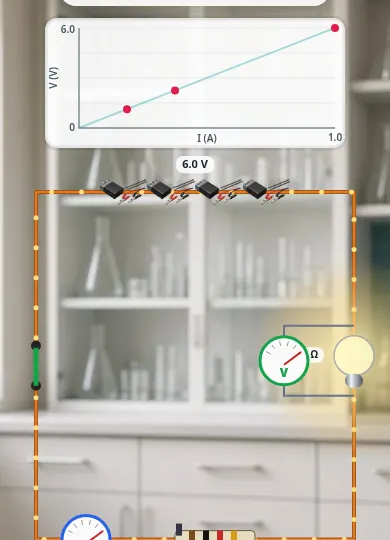
A circuit is a loop that electricity flows around. More batteries push more current, and the bulb glows brighter. A resistor makes it harder for the current to flow, so the bulb gets dimmer.
The cells push charge around the circuit. Current is how much charge flows each second (amperes). Resistance slows the current (ohms). The voltmeter across the bulb and the ammeter in the loop show that V/I stays the same: that is the bulb's resistance.
voltage = current × resistance
Why?
In a series circuit the same current flows through every part, and the total resistance is the sum: I = V_cells / (R_bulb + R_var). The bulb's power is P = I²R, so a bigger current makes it much brighter.
College
With an ideal 6 Ω bulb the V–I graph is a straight line through the origin, slope 6 Ω. A real filament is non-ohmic: its resistance rises as it heats up, so its V–I graph curves. Real cells also have internal resistance, ignored here.
▶
- Press Close switch to light the bulb.
- Change the number of cells or the resistor to take 3 readings.
- The points form a straight line: V = I R.
⚠ Safety
Never experiment with mains electricity from wall sockets. It can kill.
⭐ Fun fact: Georg Ohm published his law in 1827. At first many scientists rejected it.