Pendulum timer
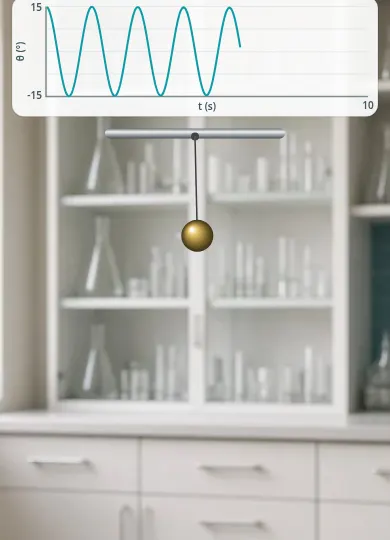
A pendulum swings back and forth at a steady rhythm. A longer string swings more slowly. On the Moon, where gravity is weaker, it swings more slowly too.
The period is the time for one full swing, there and back. It depends on the length and on gravity, but not on the mass. For small angles, how far you pull it hardly matters either.
a longer pendulum swings more slowly; the mass does not matter
Why?
Gravity pulls the bob back towards the middle with a force proportional to its displacement (for small angles), so it moves in simple harmonic motion with T = 2π√(L/g).
College
The full equation θ″ = −(g/L) sin θ is solved here with RK4. For larger amplitudes the period grows: T ≈ T₀(1 + θ₀²/16 + …). At 60° it is about 7% longer than the small-angle formula.
T ≈ T₀ (1 + θ₀²/16 + …)
▶
- Set the length and angle, then press Release.
- Now change the length and release again. Does the period change?
- Try the Moon or Mars too!
⭐ Fun fact: Galileo is said to have noticed in a cathedral that a swinging lamp kept the same rhythm, timing it with his pulse.